Modeling Visual Enumeration Using Cumulative Link Regression

Anthony D. Cate, Ph.D.

Virginia Tech

Before we begin

How many processes for enumeration?

Which of these two results suggests that participants were relying on two different enumeration processes to inform their judgments?

Overview

Main points

  • Enumeration: potentially multiple processes

  • Methods for measuring discontinuities in enumeration performance

  • Two problems to address:
    • How to measure enumeration performance
    • How to distinguish different processes based on this measure?
  • Proposed solutions
    • Measurement of performance: Cumulative link models (CLMs)
    • Criterion for different processes: Monotonicity of percept w.r.t. numerosity

How can we identify processes that are the basis for enumeration responses?

  • I will propose a method for modeling enumeration processes

  • Relies on 3 assumptions

    1. Percepts can correspond to non-integer quantities
    2. When more than one process, choose the largest percept
    3. Functions of perceived numerosity should be completely monotonic

How to model enumeration processes?

Subitizing is a performance phenomenon

  • Subitizing is an example of an enumeration process that applies to a distinct domain of numerosities (ca. 1-4)
  • Distinct from counting or estimation

    • Jevons (1871)
    • Kaufman & Lord (1949)
  • Defined as highly accurate, efficient and uniform enumeration performance within the domain

    • Mandler & Shebo (1982)
  • Especially pronounced in younger children

    • Klahr (1973)

Subitizing is a performance phenomenon

Fitting methods

Methods for measuring discontinuity

  • Most methods involve fitting functions to accuracy or RT data.

  • Those methods assume that those dependent measures reflect the efficiency of processing for different numerosities

    • Not directly related to measuring the mental magnitudes upon which responses are based
  • This is a problem especially since the relationship between perception of number and accuracy could be very nonlinear

    • As an example, consider a psychophysics experiment where responses must be integers

Accuracy is a poor dependent measure

Model of accuracy for integer responses to magnitude

\[ f(x; \mu, \sigma^2) = \left\{ \begin{array}{ll} \mathbf{\Phi}\left(\frac{(x + \tfrac{1}{2}) - \mu}{\sigma}\right) - \mathbf{\Phi}\left(\frac{(x - \tfrac{1}{2}) - \mu}{\sigma}\right) & \mbox{if } x > 1 \\ \mathbf{\Phi}\left(\frac{(x + \tfrac{1}{2}) - \mu}{\sigma}\right) - \mathbf{\Phi}\left(\frac{0 - \mu}{\sigma}\right) & \mbox{if } x = 1 \end{array} \right. \]

  • \(\mathbf{\Phi}\): the cumulative distribution function for \(\mathcal{N}(\mu,\sigma^2)\)

  • Parameters defined as functions of \(x\): for example, \(\mu = kx^\lambda\) and \(\sigma^2 = ax\).

  • Method for modeling enumeration assumption #1:

    • Percepts aren’t necessarily limited to integer quantities of magnitude

CLM Overview

  • Instead of measuring accuracy, better to use a regression method that distinguishes latent percepts from overt responses

  • Cumulative link model: a GLM for when response variable is ordinal

    • As with the integers
  • Permits various link functions

    • Probit, logit, etc.
  • Similar to logistic regression in that it models the probability of categorical responses

CLM equations

\[ P(Y_i \le j) = \gamma_{ij} = \mathbf{\Phi}\left(\frac{\theta_j - \mathbf{x}_i^\top\mathbf{\beta}}{\exp\left(\mathbf{z}_i^\top\mathbf{\zeta}\right)}\right) \qquad i = 1,\ldots,n \qquad j = 1,\ldots,J \]

\(\theta_j\): intercept parameters that are ordered, and which serve as response thresholds for the different responses:

\[ - \infty \equiv \theta_0 \le \theta_1 \le \ldots \le \theta_{J-1} \le \theta_J \equiv \infty \]

\(\zeta\): log scale parameters (account for different variance associated with I.V.s)

CLM procedure

CLM Results

Accuracy data from a dot enumeration experiment

Numerosities 1-6

CLM results

Fixed effects model

CLM vs CLMM

  • CLMM = Cumulative Link Mixed Model (permits subjects as random effects)

  • R software package ordinal (Christensen, 2011) CLMM procedure does not yet allow for scale parameters

  • However, location parameters (beta weights) are nearly identical when estimated with and without scale parameters in model

Distinguishing different enumeration processes

Criterion for distinct processes

For a given numerosity domain (e.g. 1-4, 6-10, etc.)

Are responses all based on the same process, or on multiple processes?

  • Assumption #2:

    • When multiple processes available, participants base responses on the process that yields the largest percept

    • This is a good heuristic because numerosity is usually underestimated

    • Other processes don’t contribute to response

Criterion for distinct processes

  • Assumption #3:

    • Numerosity percepts from any single enumeration process can be described by a function that is completely monotonic.

\[ (-1)^n f^{(n)}(x) \ge 0 \]

  • Not only should perceptual magnitude of successive numerosities increase monotonically, but any rate of change should also change monotonically.

  • I.e. any derivative should not change sign across its entire domain.

Criterion for distinct processes

  • A violation of complete monotonicity of the function of perceived numerosity
  • Evidenced by a significant change in the sign of its second derivative

Evidence for distinct enumeration processes

CLMM analysis

Data from a dot enumeration experiment

Numerosities 1-10

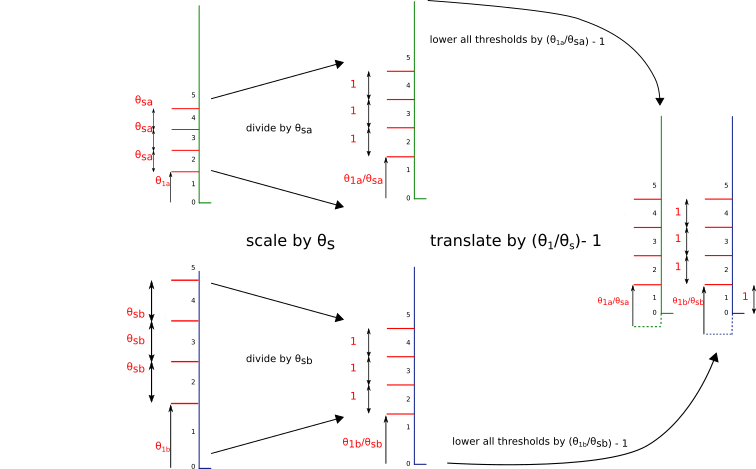
Normalization method

Normalization method

Normalization allows comparison across studies

Conclusions

Conclusions

  • Accuracy measures should not be used to infer perceptual magnitude of small numerosities

    • Due to the requirement that responses be integers
  • CLMs are the appropriate procedure for analyzing enumeration responses

  • I propose a criterion for identifying when enumeration responses are based on multiple processes vs. a single process

  • These methods can be applied to current debates about the difference between subitizing, counting, and estimation …

    • … including how they are used by different kinds of individuals
  • These methods provide a standard, consistent means for comparing the perception of numerosity across studies

Supplemental slides

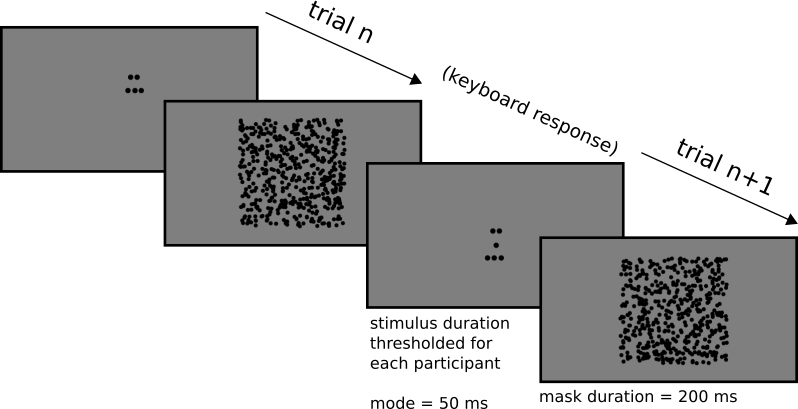
Dot enumeration experiments

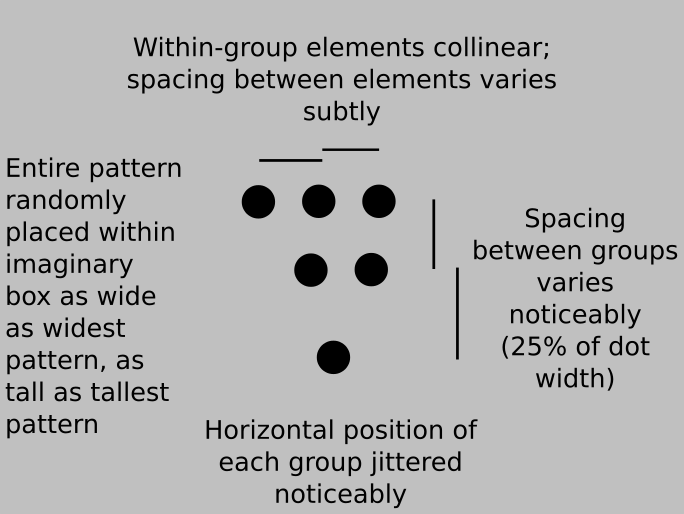
Dot enumeration stimuli